


whims & ponderings with


Jordan Rill
Ferris Bueller's Day Off x IKEA
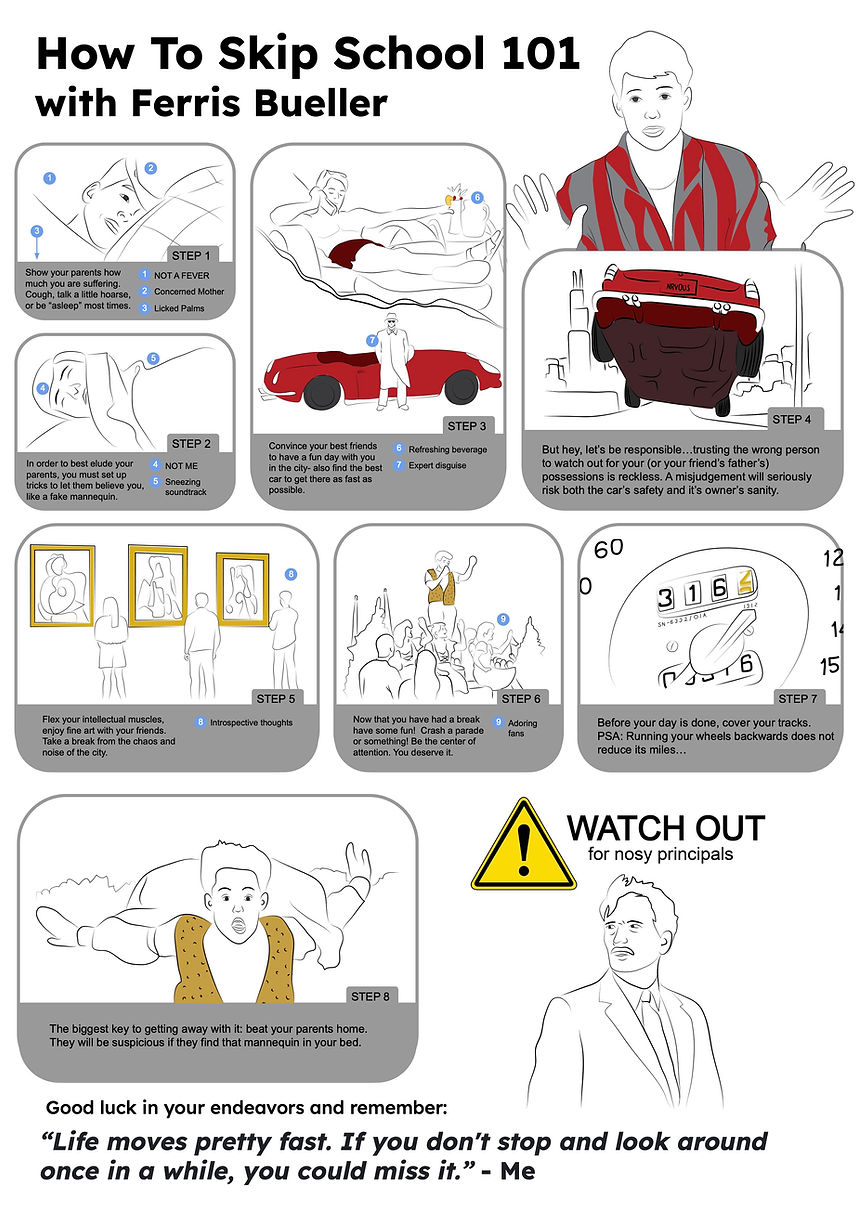
For this project, we were instructed to mix two genres in order to create something new. Here is if Ferris Bueller's Day Off was an instruction manual:
THE INS & OUTS OF THIS MANUAL
The Remixed Text
Genre Conventions
For our project, we decided to create an instruction manual to teach students how to skip school. We based the instruction manual on an IKEA set of assembly instructions and used the conventions we found to create an outline for our manual. IKEA was one of the pioneers in flat-packaging of furniture, or furniture made in small pieces and shipped to consumers for them to construct. However, shipping the furniture unassembled created issues with user assembly. IKEA solved this issue by creating an instruction manual. These manuals have been a staple of IKEA and have become popular in culture. For our project “How to Skip School 101,” we pulled ideas from the film Ferris Bueller’s Day Off and created drawings based on scenes from the movie. The main idea of the movie is that the main character, a boy named Ferris Bueller, decides that the day is far too nice to spend in school. He convinces his parents he is sick and takes his best friend and girlfriend out for a day in Chicago filled with mischief. He must enjoy his day while eluding his high school principal, who makes it his mission to catch Ferris. For our remix to be successful, we had to capture the key moments from the film, while still utilizing the sarcastic tone and uplifting story Ferris tells. We created this remixed instruction manual for all K-12 students who want to successfully skip school. There is no better way to learn than by using Ferris’s story.
An instruction manual uses simple descriptions to display how to complete something. These descriptions could be images and/or text to help explain what needs to be accomplished. These manuals have a wide range of usages, from operating complex machinery, staying safe in a dangerous workplace, fixing an issue on a smartphone, to assembling furniture. Most manuals are printed on paper and either arrive with a product when purchased or are given out depending on the context. However, in the modern world, many of these manuals are being posted online, with similar overall formatting and styles. We are using the basic conventions of an instruction manual such as the signature rounded corners, generic fonts, and tabs for additional information in order to illustrate how to skip school. All of these aspects help to create a realistic, yet simple manual that could have been made by Ferris. Movies are one of the most commonly consumed media in the modern world. The first motion picture was created in the late 1800s and has grown in popularity and complexity. Modern film contains both audio and visual aspects to it, combining to create a cohesive story. Films can be based on a true event or fictional story, used for entertainment and/or to inform an audience about a topic. Movies have become one of the most popular forms of entertainment and can be watched in a theater, phone, or even on an airplane. Most of the time, films take place in a contained environment which helps to draw the audience into the plot. However, Ferris Bueller’s Day Off breaks this convention as it adds to the film's personality. We decided to use these two genres because they can be easily combined to create a cohesive assignment. The instruction manual will be the baseline design into which we will place the conventions and plot points of Ferris Bueller’s Day Off. The formatting will be based on the instruction manual because they are used to explain how to accomplish a task. The aspects of film allow for the easy transfer of both visual and text examples directly from the movie.
Composing Decisions
Reflecting on Genre
For the remix, we wanted to keep the compositional aspects of an instruction manual and add others from specific IKEA manuals. For example, we designed our manual to keep common themes for skipping school together in the same row. The first row is how to avoid going to school, help your friends to enjoy the day, and stay safe on your day off. The second row is to enjoy the new freedom found not in school. The final frame is avoiding being caught skipping school. All of the steps came from specific scenes in Ferris Bueller’s Day Off to successfully combine the genres. Most instruction manuals contain both visual and text elements. We recreated drawings of frames in the film to match the style of IKEA manuals. We also added text and comments on famous quotes from the film to better blend the two genres. IKEA manuals have a character in the corner to help explain what to do. This aspect can be easily mirrored as Ferris commonly breaks the fourth wall in the film. In turn, we recreated Ferris in his iconic bathrobe in the corner, portraying the idea that this is his manual on how to skip school. Most manuals have warnings about what can go wrong. We incorporated this convention by picturing Ferris’s principal at the bottom with the caution symbol. All of these elements help to create a combination of an instruction manual written by Ferris's personal experience when skipping school.
This project helped us to understand the concept of genre by combining two polar ideas. Within the film genre, there is a wide range of complexity and genres, from animated cartoons for children to depicting the grimmest events in human history. The extensive scope of movies made it so the instruction manual could be based on anything, however, the light-heartedness of Ferris Bueller’s Day Off and its constant popularity within the modern culture pulled us to our decision. Before starting this project, we were unsure about the instruction manual being considered a genre. Upon further thought, we realized it was definitely a type of genre. Like movies, instruction manuals have many different types of uses, from user training, to repair manuals. All of these more narrow genres can be combined to have specific purposes underneath the umbrella of instruction manuals. This fact has reshaped our view of the genre. At first, we considered genre to be just within a general topic, such as horror, action, and comedy within films. However, our view has shifted to a more general view, such as films, television shows, and documentaries being within the genre of visual media. The more specific genres still exist, however, our view has become more open-minded to the extent of genre possibilities.
Made in collaboration with Ryan Groban and Jared Kasten

The Process
PLAY ME
